
Do I Need an LLC? A Practical Guide for Small Businesses in Massachusetts
 One of the most common questions new business owners ask is:
“Do I need an LLC?”
For freelancers, consultants, service providers, and small businesses, forming a Limited Liability Company (LLC) is often one of the simplest and most effective ways to create legal protection and structure for a business. But an LLC is not necessary in every situation, and understanding when to form one and how it works can help you make the right decision for your business.
This guide walks through the basics for businesses operating in Massachusetts.
When Should I Form an LLC?
Ideally, a business owner forms an LLC before beginning operations.
That means before:
- Signing contracts
- Opening business bank accounts
- Hiring employees or contractors
- Accepting clients
- Purchasing equipment
- Taking on business risk
An LLC does not operate retroactively. If you sign contracts or incur liabilities before the LLC exists, those obligations typically remain your personal responsibility. In some cases, contracts can later be assigned to the LLC, but that requires agreement from the other party and does not always fully eliminate prior liability.
A Special Note on Real Estate
If your business will own real estate, forming the LLC before purchasing property can be particularly important. Transferring mortgaged property into an LLC after the purchase may trigger a due-on-sale clause, meaning the lender could require the loan to be repaid immediately. For that reason, it is generally advisable to establish the entity before acquiring property intended for the business.
What Protection Does an LLC Provide?
The key feature of an LLC is limited liability protection. This means the business exists as a separate legal entity from its owner. If something goes wrong in the business (such as a lawsuit, unpaid debt, or contractual dispute) the liability is generally limited to the assets of the business, not the owner’s personal assets. Without an entity, a business owner is typically operating as a sole proprietor, meaning there is no legal separation between the person and the business. However, it is important to understand that the liability protection only works when the business is properly maintained as a separate entity.
How Do You Actually Use the Liability Protection?
Forming an LLC alone is not enough.
To preserve the liability protection, business owners should:
- Maintain separate business bank accounts
- Sign contracts in the name of the LLC
- Avoid mixing personal and business funds
- Maintain basic company records
- Follow required state filings
If the owner fails to treat the LLC as a separate entity, a court may disregard the entity structure in certain circumstances.
What Happens If the Business Faces a Lawsuit or Debt?
If the business encounters serious financial trouble, several outcomes are possible depending on the situation.
Common options include:
- Resolving the dispute through settlement
- Paying the obligation through business funds
- Insurance coverage addressing the claim
- Restructuring the business operations
- In some cases, dissolving or bankrupting the business entity
The key advantage of the LLC structure is that these issues generally remain within the business, rather than directly affecting the owner’s personal finances.
Why Choose an LLC Instead of a Corporation?
For most small businesses, an LLC offers a balance of simplicity and protection. Compared to corporations, LLCs generally provide:
Operational simplicity
LLCs require fewer formalities than corporations. For example, corporations typically require formal shareholder meetings and board governance structures.
Flexible ownership structure
LLCs can be owned by one person or multiple members.
They can also be structured as:
- Member-managed (owners run the business)
- Manager-managed (owners appoint managers to run operations)
You can learn more about that distinction here.
Simpler internal documentation
The primary internal document for an LLC is the Operating Agreement, which governs ownership and operations. Although Massachusetts does not require an operating agreement, it is strongly recommended. (Here is more information for single-member LLCs considering an Operating Agreement.)
A Note on PLLCs v LLCs
If your business provides licensed professional services, it is important to understand that in Massachusetts you may be required to form a Professional Limited Liability Company (PLLC) rather than a standard LLC.
Certain licensed professions such as healthcare providers, attorneys, accountants, architects, and other regulated professionals may need to operate through a PLLC depending on the applicable licensing rules.
While PLLCs share many similarities with traditional LLCs, there are important differences relating to:
• ownership requirements
• licensing oversight
• liability rules for professional services
• regulatory approvals that may be required before formation
Because these rules vary depending on the profession, it is important to confirm that you are forming the correct type of entity for your business activities.
You can read more about these distinctions in our article: Understanding the Difference Between a PLLC and an LLC in Massachusetts here.
Taxation of LLCs in Massachusetts
By default, LLCs are treated as pass-through entities for tax purposes. This means the profits and losses of the business are reported on the owner’s personal tax return, avoiding corporate-level taxation.
However, LLCs also offer flexibility. An LLC may elect to be taxed as an S-Corporation, which can provide tax planning opportunities depending on the size and structure of the business. Because tax considerations vary significantly, business owners should consult with both a business attorney and accountant when making this decision.
Massachusetts LLC Formation Basics
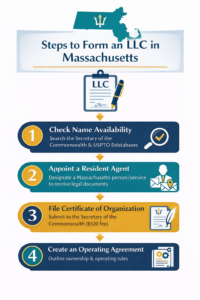
To form an LLC in Massachusetts, the following steps are generally required:
- Check Name Availability
The business name must be available through the Massachusetts Secretary of the Commonwealth database.
It is also advisable to search the USPTO trademark database to avoid potential trademark conflicts.
- Appoint a Resident Agent
Massachusetts requires an LLC to designate a resident agent located in the state who can receive legal notices and official correspondence. (Learn more here)
- File a Certificate of Organization
The LLC is officially created by filing a Certificate of Organization with the Massachusetts Secretary of the Commonwealth.
The filing fee is currently $520.
- Create an Operating Agreement
Although not required by statute, an Operating Agreement is strongly recommended to define:
- Ownership structure
- Management authority
- Profit distribution
- Decision-making procedures
Ongoing Compliance for Massachusetts LLCs
After formation, Massachusetts LLCs must file an Annual Report each year on the anniversary of the original formation date.
The filing fee is currently $520 annually.
Maintaining compliance helps ensure the business remains in good standing with the Commonwealth.
Do I Always Need an LLC?
Not necessarily.
If a business has:
- minimal risk
- limited revenue
- very small operational scope
a sole proprietorship may sometimes be sufficient in the earliest stages.
However, once a business begins to grow, has more than one owner, take on clients, sign contracts, or generate meaningful revenue, forming an LLC is often a prudent step.
An LLC is not the right structure for every business, but for many small businesses and service providers it offers an effective combination of:
- liability protection
- operational flexibility
- tax simplicity
When paired with insurance and strong contracts, it becomes part of a broader strategy for protecting your business.
This content is for general educational purposes only and does not to provide any specific legal advice. By using this Site you understand that there is no attorney-client relationship between you and Trident Legal. This information should not be used as a substitute for competent legal advice from a licensed professional attorney in your state.