
ICE Preparation and Response Plan: Business Resource Guide
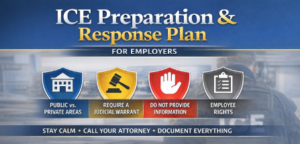 This resource is designed to help businesses prepare for and respond to visits from U.S. Immigration and Customs Enforcement (ICE) or other Department of Homeland Security (DHS) officials in a calm, lawful, and professional manner. It is intended as practical business guidance focused on workplace operations, safety, and risk management.
Important Disclaimer
This material is provided by Trident Legal LLC for educational and informational purposes only. It does not constitute legal advice and does not create an attorney-client relationship. Immigration enforcement situations are highly fact-specific. Businesses should consult qualified legal counsel to tailor policies and responses to their particular operations and circumstances.
1. Core Legal Concepts
Public vs. Private Areas:
– Public areas are spaces open to the general public, such as lobbies, waiting rooms, retail floors, or dining areas.
– Private areas are not open to the public and include offices, classrooms, staff-only areas, break rooms, kitchens, storage rooms, back-of-house areas, and any space marked or treated as restricted.
ICE agents may enter public areas without permission. Entry into private areas generally requires either the business’s consent or a judicial warrant signed by a judge.
Warrants:
– Only a judicial warrant signed by a judge authorizes ICE to enter private areas without consent.
– Administrative warrants or notices issued by ICE or DHS that are not signed by a judge do not authorize entry into private areas.
Rights:
– Individuals have the right to remain silent and the right to speak with an attorney.
– Remaining silent means not answering questions or providing explanations or documents.
2. Proactive Preparation (Before Any ICE Visit)
Designate an ICE Response Team:
– Identify a primary ICE Point Person and at least one backup.
– Identify legal counsel to contact immediately if ICE appears.
– Identify an internal note-taker responsible for documenting events.
Label and Secure Private Areas:
– Clearly label private areas with signage such as: “Private Area – Staff Only – No Public Access.”
– Keep doors to private areas closed and locked when feasible.
– Use access controls (keypads, badges, staff supervision) where appropriate.
Employee Training:
– Train employees to immediately direct ICE agents to the designated Point Person.
– Train employees not to provide information, answer questions, or grant consent to enter private areas.
– Provide simple scripts employees may use (e.g., “I am not authorized to speak for the company.”).
Information Management:
– Limit access to sensitive employee, customer, and student information.
– Do not leave rosters, schedules, or personnel records visible in public areas.
3. If ICE Arrives at Your Business
Step 1: Stay Calm and Professional
– Do not argue, obstruct, or physically interfere.
Step 2: Keep ICE in a Public Area
– Politely ask agents to remain in a public area while management is contacted.
Step 3: Identify and Document
– Request agent names, badge numbers, agency affiliation, and reason for the visit.
– Record the time of arrival and number of agents present.
Step 4: Request and Review Any Warrant
– Ask to see a judicial warrant before allowing entry into any private area.
– Review the warrant carefully for judge’s signature, correct address, and scope.
Step 5: No Consent Without a Judicial Warrant
– If no judicial warrant is presented, clearly state that the business does not consent to entry into private areas.
Step 6: Contact Legal Counsel Immediately
– Notify designated counsel as soon as ICE appears.
Step 7: Do Not Provide Information
– Do not confirm whether specific individuals are present.
– Do not provide schedules, addresses, employment records, or immigration information.
– Do not assist ICE in locating individuals unless legally required.
Step 8: Document the Interaction
– Keep detailed notes of everything that occurs.
4. Recording and Documentation
Businesses may document ICE interactions from lawful vantage points as long as recording does not interfere with operations. Video recording is generally permissible. Audio recording should only occur if all parties are informed that audio recording is taking place. A best practice is to clearly announce that video and/or audio recording is occurring.
5. Employees, Patrons, and Third Parties
Employees:
– Employees have the right to remain silent and to request an attorney.
– The business should not compel employees to answer questions or provide documents beyond what is legally required.
Patrons, Customers, and Visitors:
– The business should not provide information about customers or visitors.
– Staff should not assist ICE in identifying or questioning patrons.
If ICE Detains or Removes a Person:
– Document what occurs, including where the person is taken if known.
– Notify legal counsel immediately.
– Do not interfere with enforcement actions, but do not assist beyond legal obligations.
6. Handling Documents and Records
– If ICE requests or attempts to seize documents, request to review the request with legal counsel.
– Ask for copies or an inventory of any documents taken.
– Distinguish between on-site enforcement actions and formal document inspections or audits.
7. Special Procedures When Minors Are Present (If Applicable)
– Ensure minors are supervised by trusted staff in a private area.
– Do not allow minors to be questioned without a parent or guardian present.
– If parents or guardians are not on site, contact them immediately using emergency contact information.
– Do not release a minor to anyone other than a verified parent, guardian, or authorized emergency contact unless directed by legal counsel.
8. After ICE Leaves
– Prepare a written incident report promptly.
– Preserve all notes, recordings, and documents.
– Consult legal counsel regarding any follow-up obligations.
– Debrief management and update training or procedures as needed.
9. Education and Ongoing Training
Businesses should periodically educate employees on:
– Public vs. private areas
– The importance of not providing consent or information
– Employee rights to remain silent and seek counsel
Training should be practical, neutral, and focused on workplace procedures and safety.
10. Conclusion
Advance preparation and clear internal procedures allow businesses to respond to ICE visits professionally, protect private spaces, respect individual rights, and minimize operational disruption.