
Protecting Your Small Business: The Limited Liability Trifecta
Many small business owners start their businesses informally. A freelance designer begins taking clients. A consultant launches a website. A fitness coach starts offering training sessions. At the beginning, it may feel unnecessary to worry about legal structure or formal protections.
But as your business grows, one of the most important questions becomes:
How do I protect myself if something goes wrong?
This is where forming a legal structure like a limited liability company (LLC) can play a critical role. There are a number of different types of legal structures. You can learn about the different options and distinctions here. Often an LLC is the best entry option so you will hear that referenced within this article but it is not a one size fits all solution and you should consult with counsel when evaluating your options.
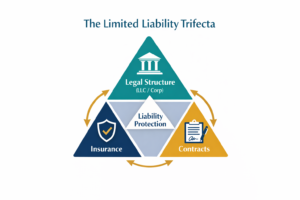
However, a limited liability entity alone is not a complete solution. True protection for a small business comes from what I often describe as the Limited Liability Trifecta.
Think of it as a triangle with three sides supporting your business.
If one side is missing, the structure becomes unstable. When the triangle is complete the owner stand protected from all three sides.
The Limited Liability Trifecta
Imagine liability protection as a triangle made up of three essential components:
- Legal Structure (LLC or Corporation)
- Insurance
- Contracts
Each of these works together to reduce risk and protect both the business and the business owner. When all three are in place, you create a much stronger foundation for operating and growing your company.
- Legal Structure
The first side of the triangle is the legal structure of the business itself. When someone operates a business without forming an entity, they are typically operating as a sole proprietor by default. If there is more than one person operating the business in an ownership capacity then you have created a general partnership which can be even more problematic as you could have joint and several liability from your partner without the legal separation of the business from its owners.
That means:
- There is no legal separation between the owner and the business
- The owner may be personally responsible for business liabilities
- Personal assets such as bank accounts, homes, and savings may be exposed
An limited liability entity creates a legal separation between the individual and the business.
This structure helps limit the owner’s personal liability for business obligations and claims. If the business is sued or incurs debts, the liability is generally limited to the assets of the business, not the owner personally.
For many service providers and small businesses, an LLC offers:
- Liability protection
- Professional credibility
- Flexible tax treatment
- A clear legal structure for growth
But forming an LLC is only one part of the protection strategy.
- Insurance: Protecting Against Real-World Risk
Even with an LLC, lawsuits and claims can still happen. Insurance acts as the second layer of protection by helping cover financial losses that could otherwise threaten the business.
Depending on the type of business, common policies may include:
- General Liability Insurance – protects against third-party injury or property damage claims
- Professional Liability (Errors & Omissions) – protects service providers from claims related to professional advice or services
- Cyber Liability Insurance – protects businesses handling digital information
- Workers’ Compensation Insurance – required when businesses have employees
Insurance doesn’t replace the LLC. Instead, it works alongside it. If the LLC is the legal shield, insurance is the financial safety net.
- Contracts: Managing Risk Through Agreements
The third side of the triangle is contracts. Contracts help define expectations, allocate risk, and establish clear rules between parties.
For small businesses, important contracts may include:
- Client service agreements
- Independent contractor agreements
- Employment agreements
- Vendor agreements
- Partnership or collaboration agreements
Well-drafted contracts can:
- Limit liability
- Clarify responsibilities
- Establish payment terms
- Define dispute resolution procedures
- Protect intellectual property
Without contracts, many disputes become far more complicated and costly to resolve. Contracts serve as the rules of engagement for your business relationships.
The Missing Piece Many Businesses Overlook
Even when a business has an LLC, insurance, and contracts, there is one additional factor that determines whether the liability protection actually works:
Maintaining the separation between the business and the owner.
This means:
- Keeping separate bank accounts
- Signing contracts in the name of the business
- Maintaining basic corporate records
- Avoiding mixing personal and business funds
When the business is treated as truly separate from the owner, the liability protections are far more likely to hold up if they are ever tested.
Building a Strong Foundation for Growth
For small businesses and solo service providers, legal protection does not have to be complicated. But it should be intentional.
The Limited Liability Trifecta provides a simple framework:
Entity Structure + Insurance + Contracts
When these three elements work together, they create a strong legal and financial foundation that allows business owners to focus on what matters most, serving clients and growing their businesses.
This content is for general educational purposes only and does not to provide any specific legal advice. By using this Site you understand that there is no attorney-client relationship between you and Trident Legal. This information should not be used as a substitute for competent legal advice from a licensed professional attorney in your state.